
A Complex Mosaic
Part IV of Are We Giving the Land Something Like Alzheimer's.

(Note: This piece may exceed your Google inbox limit. For the best reading experience, go to The Climate According to Life.)
Welcome to part IV of the series, Are We Giving the Land Something Like Alzheimer’s?, an exploration of forest intelligence and memory, and how logging might affect it.
In Part I, I explained the origins of this inquiry, how, in 2017, I heard some Lakota saying that elders were detecting “something like Alzheimer’s” in the Black Hills of South Dakota, as though the hills were “forgetting.” Much later, in 2025, a friend sent me an article about expanding tree thinning in the Black Hills in response to a Mountain Pine Beetle outbreak that ended in 2016. I immediately recalled the words heard eight years earlier, about “something like Alzheimer’s” in the mountains. Did all that thinning, plus beetle kill, have something to do with what those Lakota elders were reporting?
And what exactly were those Lakota elders reporting? All I know of it is a comment I heard, but it seems a particular powerful observation, and points to an indigenous perspective yet to be explored here, which I’ll attempt in the piece to follow.
At this point, we’re still looking through the Western scientific lens, exploring what science has revealed regarding forest intelligence and memory, which we discovered to be quite a lot. We saw in Part II how the seemingly motionless and passive postures of plants hide a buzz of activity. Electrical and chemical signals flow up and down phloem and xylem, performing chemical operations analogous to those found in animal cognition, even using common neurotransmitters, such as glutamate and GABA. No, they don’t have nerves or brains, but they still manage to “read” their environments, gather information, make choices, communicate information within self and to others, and record memory of things learned. From an evolutionary standpoint it makes sense. Plants came before us, developing means of cognition that may well have provided the prototype for our own. We humans didn’t invent intelligence. We just took it in new directions.
Having confirmed intelligence in individual plants, we turned in Part III to plant communities, such as forests, where once again we found communication, cognition and memory. Indeed, there is already a scientific term for it—ecosystem memory—the tendency of ecosystems to return to their original arrangements after being disturbed. The memory is not only in the trees, plants and animals, but in their relationships. This communication happens both above ground, through the release of pheromones, and underground, through fungal networks which provide the infrastructure for sharing resources and information.
If the question is “is there is intelligence and memory in forests to lose in the first place,” the answer must be yes. The next question, then, is “how might that intelligence and memory be affected by forest management practices?”
To that question we turn now.
The Black Hills are a bit like an island in a sea of prairie. Over 65 million years ago, tectonic forces pushed up a massive granite dome, puncturing through and pressing back the encircling layers of limestone. Erosion followed over millions of years to carve both granite and limestone into the geologic tapestry of spires, needles, walls and caves encountered today. Standing 1-2,000 meters above the surrounding prairies, it enjoys cooler, moister air, ideal for growing forests.
Paha Sapa is what the indigenous Lakota call it, meaning “hills that are black,” for their dark aspect when seen from the plains. For them it is a holy place, the source of their origin story and where they gather sacred plants and hold ceremonies. Though the relationships has had a practical aspect too. They hunted there, gathered plants and provisions and maintained winter camps there to escape the fierce winter winds on the plains. And according to the Fort Laramie Treaty of 1868, they still possess "absolute and undisturbed use and occupation” of the land.
The sincerity of that treaty has to be questioned, though. Six years after the US government signed it, General George Armstrong Custer was tasked with leading an expedition into the Black Hills to scout for potential fort sites, survey it’s resources and assess it’s suitability for development. Unfortunately for the Lakota, they found gold. Almost immediately, a new gold rush was on, and the words of the US government turned to air. The government eventually seized the Black Hills in an agreement which the Supreme Court, in 1980, lambasted, writing “A more ripe and rank case of dishonorable dealing will never, in all probability, be found in our history.”
Gold wasn’t all the expedition found. They also found a place of astonishing beauty and richness. On their first day into the Hills, Colonel Peter Ludlow, who authored the expedition’s official report, wrote: “The temperature was delightful; the air laden with sweet wild odors; the grass knee-deep and exceedingly luxuriant and fresh; while wild cherries, blueberries, and gooseberries abounded, as well as many varieties of flowers. All these advantages, combined with that of an abundance of pure cold water, were ours, with rare exceptions, until the the final departure from the hills. . . .” Three days later they entered a flower meadow so rich it stopped them. “Our eyes were opened then to the beauties of the Black Hills…and every man in the expedition stood silently to enjoy and admire." Custer later wrote of wild flowers so luxuriant “that men plucked them without dismounting from the saddle.. . .It was a strange sight to glance back at the advancing columns of Cavalry and behold the men with beautiful bouquets in their hands while the head gear of their horses were decorated with wreaths of flowers…”
The expedition also found forests, rich and vigorous forests, studded with ancient ponderosa pine up to three feet thick. Photographs from these expeditions sometimes show open, park-like forests, an observation that has led many to argue that aggressive thinning is needed to restore the forests to what is assumed to be its original condition. But Mary Zimmerman, long-time resident and President of the local public lands advocacy group, the Norbeck Society, believes a more complex mosaic of forest structures existed, with areas of dense forest as well as areas of open forest. She bases this on close readings of early government surveys, such as the Graves Report, which describes the Black Hills as “... in the main, densely timbered, but the forest is broken in many places by parks and mountain prairies, and enormous tracts have been entirely denuded by forest fires.” Or in Ludlow’s report of the Custer expedition, while descending Black Elk Peak Ludlow describes numerous obstacles, including “…willow and aspen thickets, pine timber, dead and fallen trees…”
And of course, those various forest structures were allowed to grow old and sort themselves out according to their own natural processes. But all that was about to change.
Within two years of gold’s discovery, the land around virtually all the creeks had been bought up for mining claims, and the Homestake Mine, the first commercial mine listed on the New York Stock Exchange, destined to become the most massive gold mine in the Western Hemisphere, had commenced hard rock mining and milling. Boom towns like Lead, Custer and Deadwood sprang up, gathering thousands of inhabitants each in a matter of months. Mine-shafts wanted timbers. Railroads wanted rail ties. The boom towns wanted planks and studs. In short order the surrounding mountainsides were stripped bare and heavily eroded. Drought ensued and in 1893 devastating fires swept through large parts of the Black Hills, fueled in part by logging slash.
This pattern was not unique to the Black Hills, but was playing out throughout the West, such that in 1891, congress passed the Forest Reserve Act, giving presidents authority to protect reserves of public land under the Department of Interior. In 1897 President Grover Cleveland used that authority to create the Black Hills Forest Reserve, a 1.2 million-acre reserve encompassing most of the Black Hills. Though the original intention was oriented toward conservation, timber and mining interests wanted continued access to the resources, as was true throughout the West. Eight years later, out of these two pressures, the US Forest Service was borne. The reserves became national forests and their management was transferred to the Department of Agriculture.
Interestingly, the United State’s first federal timber sale, known as Case Number 1, was in the Black Hills. In 1891, Homestake Mining was permitted to cut an additional 13 million board feet, but under the strictures set by the government. Depending on your perspective, this was the beginning of professional forest management in America or the beginning of corporate manipulation of the US Forest Service.
For the Black Hills, it was a sea change. For millions of years it had “managed” itself, according to it’s own intelligence, relationships and feedbacks. The last 3,000 years of those involved some level of indigenous influence, such as the burning of meadows and hunting, but forests were allowed to grow and age according to their own natural processes. That all changed under forest-wide, mechanical management.
Initially, and for the most part through the 1930’s, the practice was selective harvest. This gave way in the 40’s and 50’s to a more intensive shelterwood system, in which two stand ages, older overstory and younger understory were grown in succession, with scheduled thinning. The overstory was thinned to harvest timber and let light in to the understory, which was thinned to reduce crowding and hasten the pace of growth.
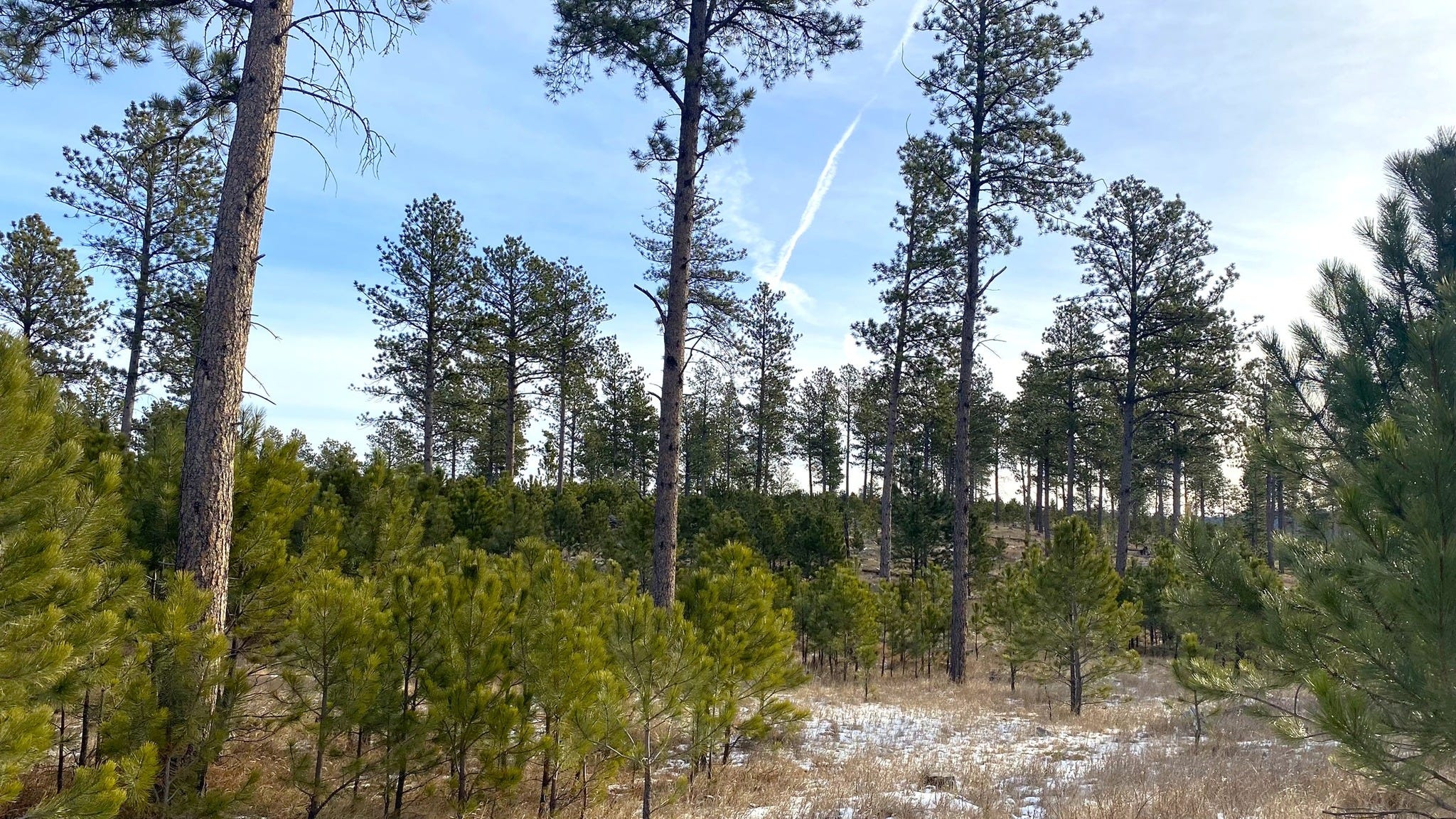
As milling technology advanced, more markets became available and the pressure intensified, such that by 1967, levels of cutting equaled those of the 21 unregulated years. The pressure also spread geographically, so that by 1974, writers of Silviculture of Ponderosa Pine: the Status of Our Knowledge, could proclaim “…the old growth pine forests of the Black Hills has been converted—with uncommon success and completeness—to a well-stocked and manageable second growth forest.” Twenty years later, researchers Shinneman and Baker would underscore the point. “No other forest type in the Rocky Mountains has received longer or more intensive management.”
If the sole goal is the growing of timber, it seemed to be working. By the mid-1990’s, due to fire suppression and management techniques, timber volume had tripled compared to it’s original, pre-management volume.
Then, in 1999, the beetles came.
What we call the Mountain Pine Beetle was first called the Black Hills Beetle, named in 1902 by the infamous, self taught entomologist, Andrew Hopkins, the first to scientifically characterize and name the beetle. Later, it was realized the beetle existed throughout the west, leading to the more general term, Mountain Pine Beetle. Whatever we call it, it is a natural part of the Black Hills ecology and has been coevolving there for 35 million years or so. And there have been outbreaks before. Government surveys in the late 1890’s note clumps of dead trees in the northern region, home to Homestake Gold Mine, where unregulated, wildcat logging had been going on for a little over twenty years. Since then, there have been sporadic, limited outbreaks throughout the Black Hills that tend to repeat at 20 year intervals.
The one that began in the late 1990’s was a big one. Local lore says the epidemic began in the Beaver Park Roadless Area in the north, with roadless protections blamed for allowing the beetles to establish themselves. But Zimmerman considers that a logging myth. “Having studied the maps from each year’s hits in sequence, I am confident that it actually erupted spontaneously all about the forest - because conditions were ripe.” By the time the outbreak subsided in 2016, up to 400,000 acres, a little more than a third of the black hills, had been affected to some degree.
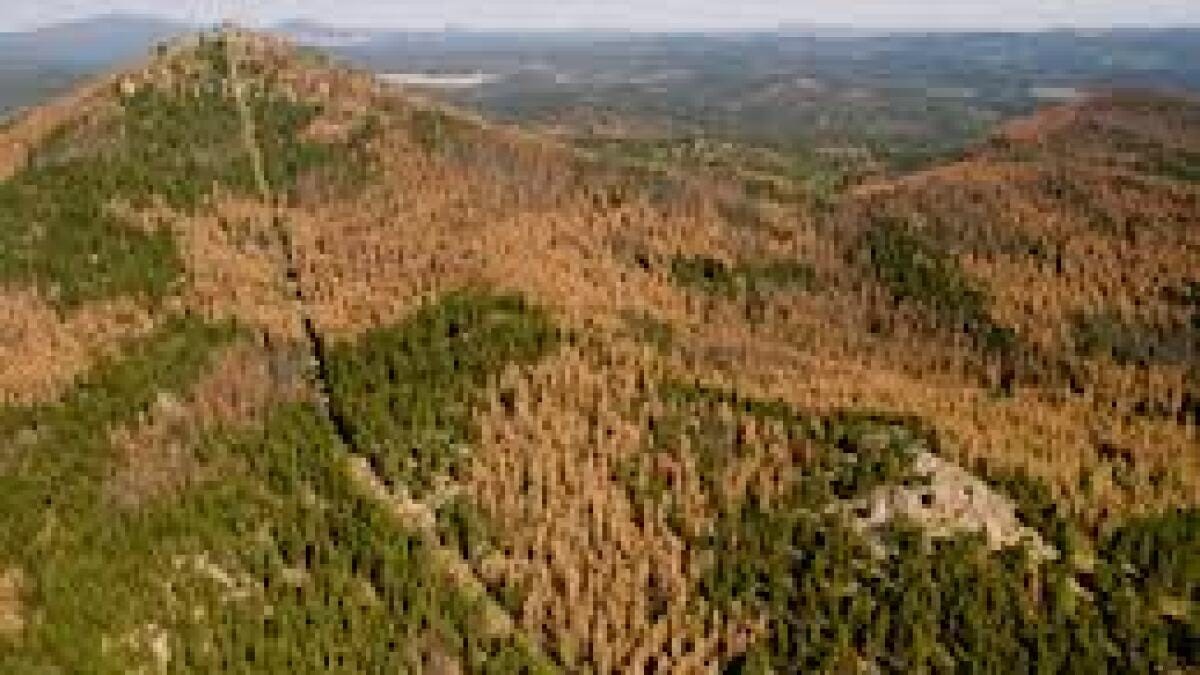
The reason Hopkins was there in the first place, was to help the government contend with the beetle’s presence. He advocated direct control, in which infected trees would be identified and either removed from the forest, cut into chunks and spread out to dry, or burned. Debarking and various pesticides applications were also attempted, the later with great fervor. None of it, however, was deemed effective, and the approach shifted to indirect control via prescriptive thinning.
To understand the logic of thinning, one must understand how the beetle spreads. It begins when a female burrows through the bark of a tree, after which she releases pheromones that call in more beetles. The goal is a mass attack capable of overwhelming the tree’s defenses. When sufficient numbers have colonized the tree, a repulsing pheromone is released, directing beetles away to other trees. Thinning, it’s believed, disrupts these pheromone plumes by introducing more wind into the stand. Also, by opening the canopy, more sunlight heats the soil, creating convective updrafts that further disrupt the plumes. The more you thin, the more wind and convection. Plot studies show a notable decline in infection at a spacing of about 20-25 feet apart, about 100 trees per acre of an average width of 9”.
The idea is to get ahead of the beetle, to render the forests windy enough to frustrate their cleverly evolved use of pheromones, and by 1999, when the outbreak began, it had become the accepted method of control by the Forest Service. According to Dave Mertz, a 32 year USFS veteran who oversaw the Black Hills timber harvests from 2011-2017, up to 20,000 acres were being thinned per year. For the local lumber mills, this was a boom, and many years saw significant increases over the allowable cut.
Then, in 2016, the infestation ended, and with it the need for such intensive, preemptive thinning. The preemptive thinning, however, continued. Further, in 2018, it expanded to include Overstory Removal, the complete removal of older, overstory trees. What was going on? In a piece entitled A Cautionary Tale—Too Much Sawmill Capacity, Too Little Trees, published in The Smokey Wire, Dave Mertz provides a simple explanation. Local timber mills had grown accustomed to a high level of timber volume during the beetle outbreak and pressured their politicians to push the Forest Service to maintain them. Meanwhile, the combination of logging, beetle kill and fire had severely diminished timber volume. The volume wasn’t there to feed the mills, which put increasing pressure on the forest remaining.
This situation prompted the creation of the Black Hills Resilient Landscapes Project, which called for up to 185,000 acres of overstory removal, as well as expanded thinning, to “increase ecosystem resilience to insect infestation and other natural disturbances, to contribute to public safety and the local economy, and to reduce the risk of wildfire to landscapes and communities.”
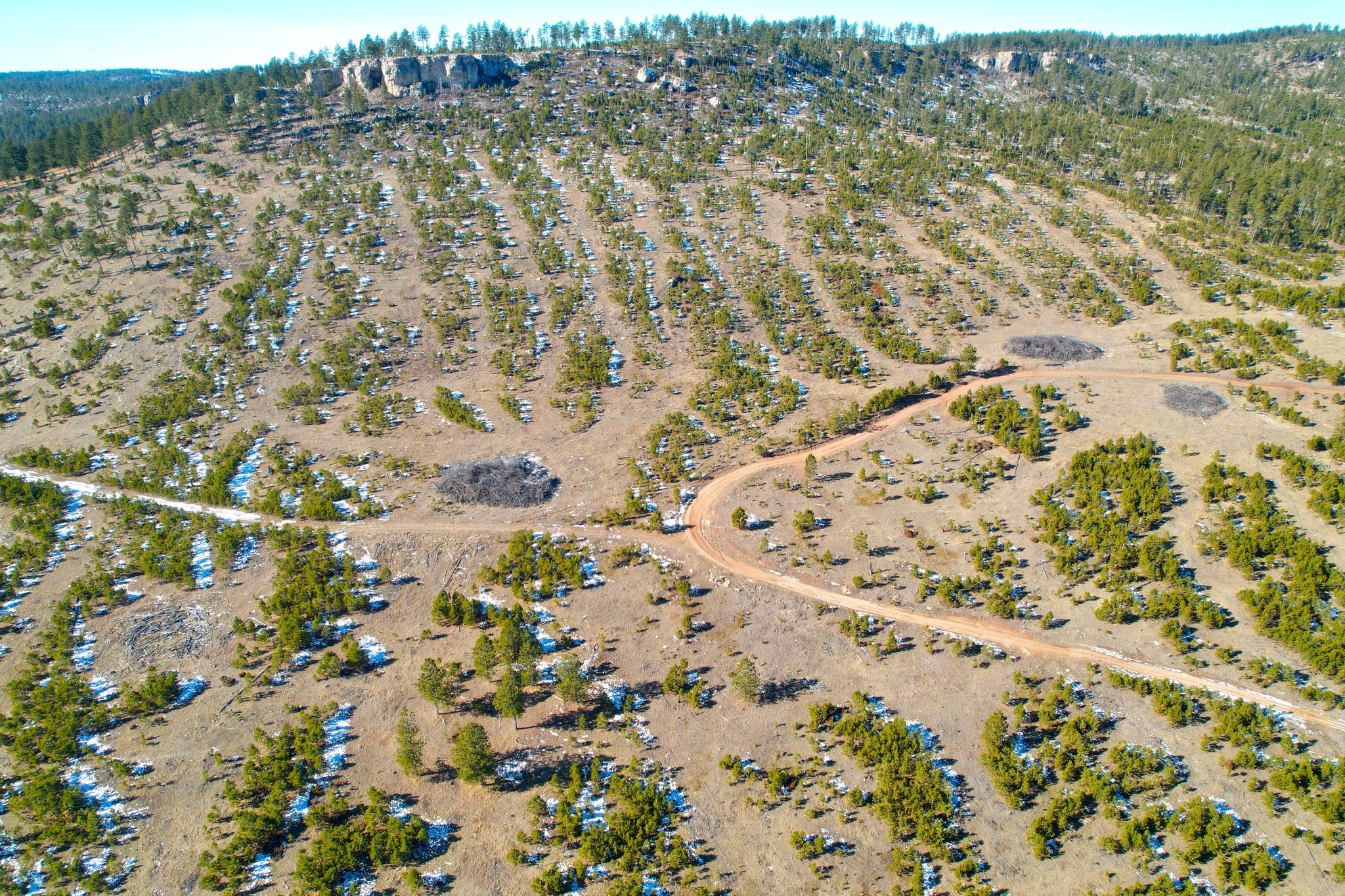
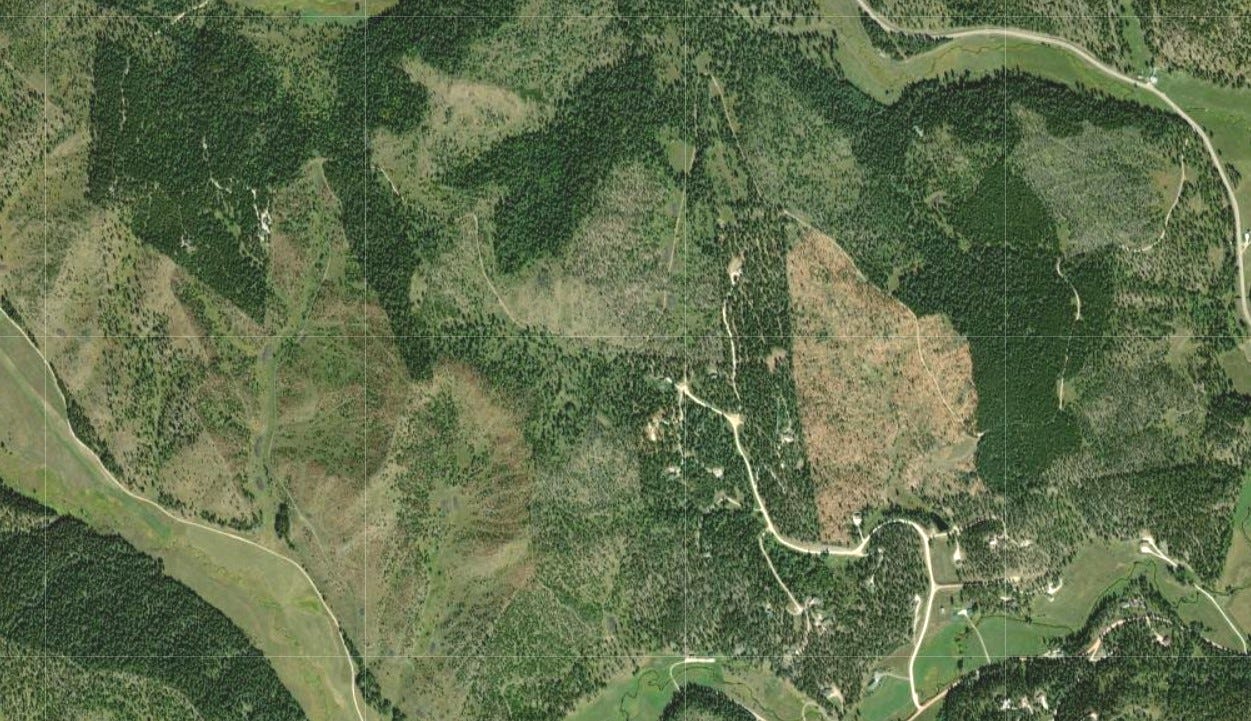
Others saw the project as a veiled attempt to justify increased harvest. Jim Furnish, second in command of the US Forest Service between 1999 and 2002, put it bluntly. In an editorial in Mountain Journal he called it “an ugly, out-of-control debacle in forestry gone wrong,” and blamed it for “reducing the forest to ecologically impoverished, even-aged tree farms, and increasing susceptibility to future fires.” But it’s not just the Black Hills. Furnish noted the same forces are at play elsewhere, with the Black Hills being a particularly dramatic example of a “decades-long drama playing out on most forests across the country.”
Where To Now?
Presently, the Forest Service appears to have scaled back logging in the Black Hills to more sustainable levels, but the damage has already been done. As Dave Mertz puts it, there are places where the forest is in “a miserable state,” with hardly any old trees left and the forest converted to “a much younger condition.” Further, the overstory removal left behind thousands of acres of rapidly growing, overcrowded “dog-hair” thickets, prime victims for fire and beetle kill. Since such stands are of little commercial value, funding is needed to treat them. Meanwhile, the political pressure to cut what’s left continues, as well as the rationale, that thinning is needed to make forests more resilient to fires and beetles.
But you may have noticed something. The strategy for combating Mountain Pine Beetle—introducing, through thinning, enough wind to disrupt the beetle’s pheromones plumes—seems to contradict the logic of thinning to protect forests from fire, as the resultant increases in wind, heat and dryness all work in favor of fire, not against it. And the question must be asked, if thinned stands are windier, drier and hotter, what then happens when entire forests are continually thinned? Are we not altering forest climates from the ground up, creating the very conditions we should be avoiding?
An interesting case is the Jasper fire, a major, high intensity conflagration that burned over 80,000 acres in 2000, despite having been methodically thinned, as Dave Mertz illustrates in this short, two and a half minute video. Despite the thinning, it burned so extensively it’s unable to regenerate on its own and requires replanting. This leaves the question, if thinning didn’t prevent the fire-spread, did it it exacerbate it? Did opening up the canopy for the sun to warm and dry the soils, while at the same time degrading the forest’s ability to break and tame wind, make it more, not less, vulnerable to fire?
There are many questions that could be asked here, but let’s return to the one we began with: what does all this look like when we widen the lens to incorporate intelligence and memory in both tree and forest? What happens when we grant the forest it’s own agency, when we recognize that for millions of years it has managed itself through long-evolved patterns, processes and relationships which, crucially, includes the entire life span of trees into old growth and decay? Tree aren’t just sitting there, they are doing things, sensing their environments, above and below ground, managing their use of water, seeding rain clouds with condensation nuclei, responding to threats and injury and communicating through pheromones, fungi and feedbacks. As Judith Schwartz puts it, the word tree should be thought of a verb. Trees tree. Forests forest.
If allowed, that is. Once converted to management, the forest loses that agency. It no longer forests but plantations. While it wants to perform a symphony, it’s forced into a productive march. It may be productive, but is there a hidden price, slowly coming due? Left alone a forest will thin itself, though it will take longer. But along the way it self selects for trees and relationships that are better adapted to circumstance and have higher survival. Mechanical thinning does not make make such distinctions.
In the early 1900’s, the entomologist, M. W. Blackman, discovered a 400-year-old ponderosa pine which he determined had survived seven unsuccessful attacks by Black Hills beetles. Those are the kinds of trees every forest needs, but such trees aren’t permitted to develop in a management scheme that harvests them by 120 years, when growth begins to slow. In a sense, the forest is kept in a permanent state of adolescence and young adulthood, never allowed to fully mature. It doesn’t get to learn. It’s a forest without elders, behaving in enforced patters largely alien to it’s history. At what point does it forget what it was?
Ultimately, this is about relationship, how we relate to the lands around us. And here too, the situation is, as always, complex. Land management agencies are not monoliths. Within their ranks are a variety of dispositions toward the forest. There are retired foresters like Dave Mertz, who support logging but want it done sustainably. Thus, the name of the Facebook group he helps run: People for Sustainable Logging in the Black Hills. Mary Zimmerman describes a complex picture where those nearer the ground who carry out the policies, even some loggers, are uncomfortable with with the extent of cutting, especially the overstory removal. As for upper management, they are under pressure from above by powerful political forces. Industry pressures the politicians and the politicians pressure the Forest Service. As Mertz puts it, “Sawmills have the politicians.”
Of course, we have so far been looking at forests and our relationship to them from a Western perspective. There are and have been other relationships, such as those of the peoples who happened to live there when Custer came through to look around. It is to their perspective we turn next.
Sources
Shinneman, D.J. and Baker, W.L. (1997), Nonequilibrium Dynamics between Catastrophic Disturbances and Old-Growth Forests in Ponderosa Pine Landscapes of the Black Hills. Conservation Biology, 11: 1276-1288. https://doi.org/10.1046/j.1523-1739.1997.96198.x
Boldt, Charles E.; Van Deusen, James L. 1974. Silviculture in the Black Hills of Ponderosa Pine: The Status of Our Knowledge. Rocky Mountain Forest and Range Experimental Station.
Graham, Russell T.; Asherin, Lance A.; Battaglia, Michael A.; Jain, Theresa B.; Mata, Stephen A. 2016. Mountain pine beetles: A century of knowledge, control attempts, and impacts central to the Black Hills. Gen. Tech. Rep. RMRS-GTR-353. Fort Collins, CO: U.S. Department of Agriculture, Forest Service, Rocky Mountain Research Station. 193 p
Mclaird, James D.; Turchen, Lesta V. 1974. Exploring The Black Hills, 1855-1875: Reports of the Government Expeditions. South Dakota Historical Society.
Graves, Henry. 1899. The Black Hills Forest Reserve.
Thanks for reading! I’m glad you’re here. I keep this page free for all and avoid littering the text with subscriber requests. But that doesn’t mean I don’t completely depend on reader-generosity to make this work possible. Please become a paid subscriber if you can.
HI Rob, Gaias Web by Dave Beck shows how beetle attack is a condition of water availability in
https://gaiasweb.substack.com/p/the-beetle-and-the-burning-forest
and from the early descriptions they describe a forest with water loving mesic species as part of the indigenous management. I covered this in part in
https://substack.com/@tcrethers/p-189242931
You are right to question this approach especially the short sightedness of dehydrating the forest to protect it. Mesic species integration could offer some protection and I wonder if anyone has studied the disruption to the pheromone signaling in such mixed forests?
Thanks for the interesting perspective as I believe the notion of forest memory runs parallel to the evolutionary climatic maximum.
Rob, this is a terrific series. Our degree of hubris is heartbreaking, the damage immense. Yet, we need to know this information that you offer so clearly. Thank you for all you are doing.