
Smokescreen
Seeing through the industry narrative on forest fires.

“There’s nothing more ecologically valuable, ton for ton, than a dead tree.”
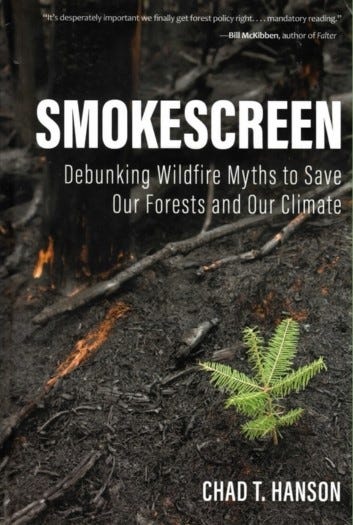
So speaks ecologist Chad Hanson in this fascinating interview with climate journalist Hart Hagan. Hanson is author of Smokescreen: Debunking Wildfire Myths to Save Our Forests and Our Climate, and Hagan does an excellent job of asking just the right questions and letting Hanson lay out the sometimes poetic, sometimes infuriating details of his premise: that we are being misled about the true nature of forest fires and how we should be dealing with them, with disastrous consequences for both wildlife and climate. Terms like “forest health,” “thinning” and “fuel reduction” are a “parade of euphemisms,” he says, that are merely “masking the same old logging that was done in the 1970’s and 1980’s.”
It was particularly interesting to listen to this interview so soon after writing about the Embracing Nature’s Complexity conference, for appreciating complexity is at the heart of his message. It’s only through seeing the complexity of fires in forests that one can understand how a dead tree has such enormous ecological value.
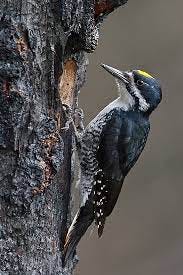
It begins with beetles, numerous species that have evolved to sense the heat and smoke of wildfires, which they fly to from all directions. As soon as the fire moves on and the wood cools, they alight on the charred bark and lay their eggs, which, upon becoming larvae, bore into the wood to continue their lifecycle. This creates a banquet for woodpeckers, such as the black-backed woodpecker, which excavate nests out of the dead, softened wood, a new one each year, providing nesting cavities for non wood-pecking birds, such as bluebirds and nuthatches as well as small mammals, like chipmunks and flying squirrels. Now there’s food for goshawks, cooper’s hawks, bobcats and foxes, and when limbs and trunk fall, there’s homes for denning as well.
Do you see? It’s all about relationships over time, a complexity which, in my opinion, gets lost in the CO2-only view of climate. “All that standing wood needs to be hauled out so it doesn’t release it’s carbon,” goes the logic, facilitating the argument for “salvage logging” and other practices which damage not only wildlife habitat, but the carbon-absorbing, water-cycle-driving capabilities of naturally regrown forests.
You’ll also learn that when the national forests were originally created, in 1891, no logging or mining was permitted on them. That’s right. They were treated as protected areas. It wasn’t until 1897, under pressure from the logging industry, that congress permitted logging in the national forests. Today, the US Forest Service is literally in the logging business, auctioning timber sales to fund its operations.
I’ll leave it there and let you watch the interview. You can also find it here, at Hart’s Substack page, which will give you a chance to peruse the excellent information Hart has amassed on water cycles, soils, plants, insects, everything having to do with the living climate. Have paper and pen on hand, as there’s quite a bit of interesting information. I’m pretty sure you’ll never look the same at forests and their fires.
Really looking forward to listening to this. Thanks Rob!
FYI, for a balancing perspective, this review paper on “Adapting western North American forests to climate change and wildfires: 10 common questions” gives the scientific consensus viewpoint.
https://esajournals.onlinelibrary.wiley.com/doi/10.1002/eap.2433