
A Breakthrough Conversation
Millan Millan's two legs of climate step deeper into the climate narrative.

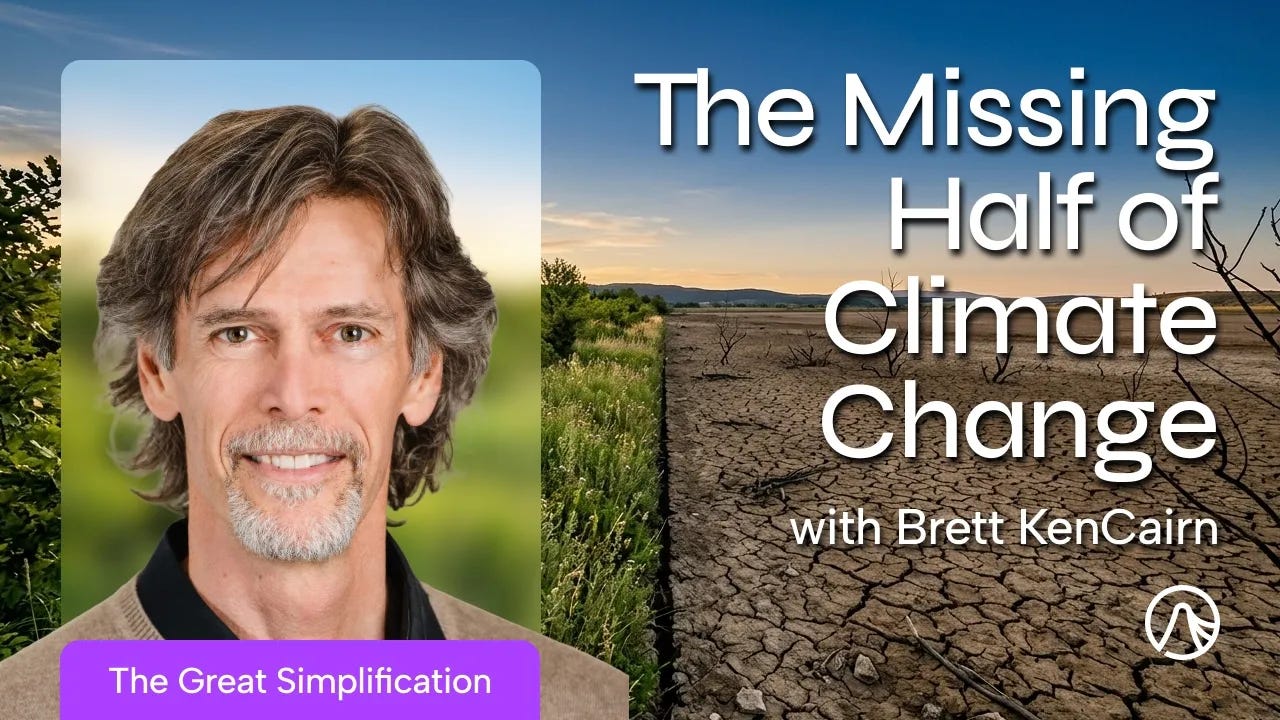
Nate Hagens is a well known and trusted figure among those of us concerned with the polycrisis. His podcast, The Great Simplification, has for many become a port in the storm, where with calm and intelligent analysis, Nate renders the chaotic strands of our age into patterns one can recognize, comprehend and confront.
Brett KenCairn runs Nature-based Climate Solutions for the City of Boulder’s Climate Initiatives Department and is the Founding Director of the Center for Regenerative Solutions. He’s also emerged as an able champion of the living climate concept, bringing the “other half of climate” to the Bioneers’ recent annual conference in a lively presentation.
Nate Hagen saw his talk and invited him on his show, resulting in a real breakthrough dialog. You could see Nate’s head nodding up and down as he took in concepts that have long remained at the periphery of respectful climate discussion. Names familiar to us, such as Didi Pershouse, Walter Jehne and Elaine Ingham, were woven in and I was especially gratified to see Brett highlight Millan Millan’s two legged understanding of climate. Excuse the pun, but it’s a big step forward in the effort to bring land degradation into the climate conversation.
Here is the link. If you want a shot of encouragement about what’s possible on this living, intelligent and oh-so-capable planet, check it out.
By the way, if you’ve yet to read my three part series on Millan’s work, here is the link. If you want a condensed version of the story, you can find it here in a piece I wrote for Acres USA.
Thanks for reading! I’m glad you’re here. I keep this page free for all but depend on reader-generosity to make this project, and the research involved, possible. Please consider a paid subscription if you can and don’t forget to hit the “like” and “share” buttons.
I also found the conversation with Brett KenCairn one of the best interview Nate Hagens has done. There were many dots connected going back to the early 80s when I read about the Amazon rainforest feeding its own rain in a study by a group of Canadian Scientists that Munn and Millan may have influenced. At the same time I ran into an Ethiopian agro-forester whose underlying interest came from an Ethiopian proverb "The trees pull the rain." Deforestation, widespread in Kenya and Ethiopia, was tied in his thinking to the conversion of forest to agriculture. He wanted to inspire a reversal of that. In some parts of Kenya this has happened, and the Ethiopian government promotes massive tree planting efforts across the entire population. It is hard to do when there is also continuous violence in the country. Combine Munn, Millan, Makarieva, Simard's work on tree interconnections, and Ingham's on soil biodiversity corresponding to plant biodiversity and you have a much better foundation on ecosystem function including climate. Thanks for the connection to Millan. I had not read of his work before.
Dear Rob. I had an opportunity to hear and listen to you a while ago, I'm not remembering where. Since then, I have developed a strong energetic sense of you as a person who is, in relation to the climate crisis, steadfast, intelligent, passionate and generous. Knowing that you are close by and continuing to stay deeply engaged with the climate in some very creative and courageous ways has helped me a lot. Here in Victoria, I live on the shores of the Sailish Sea, like you do. Where I grieve deeply for what is happening to our orcas and our oceans. (And our rivers, streams, dams, trees, and on and on and on) And continue to explore, with myself and others, how this grief can become something active, engaged and effective, in relation to this eco-system that I love. And that loves me --this is truly the place of the deepest reverence and tenderness.